By MGS Group Real Estate
Though Boston has museums with larger collections and many institutions with broader name recognition, few places are as singular as the Isabella Stewart Gardner Museum. Located at 25 Evans Way beside the Back Bay Fens, the Gardner is far from a conventional museum.
Akin to a private invitation into one person's highly individual vision of art, architecture, music, and beauty, the museum reflects Isabella Stewart Gardner's unique vision. Galleries remain arranged according to Gardner's highly specific wishes, even as the celebrated courtyard changes with the seasons. Further adding to the intrigue, empty frames still mark the site of one of history's most infamous art thefts.
More than a century after Fenway Court opened, the museum maintains a singularly personal aesthetic, equal parts eccentric and mysterious, and remains one of Boston's most compelling cultural destinations.
Key Takeaways
- Isabella Stewart Gardner opened Fenway Court to the public in 1903, creating a museum modeled in spirit on the Venetian palaces she admired.
- The courtyard is the visual heart of the museum, with dramatic seasonal horticultural displays that change throughout the year.
- Gardner's will requires the historic collection to remain substantially as she arranged it, preserving an unusually personal approach to displaying art.
- The 1990 theft of 13 works remains unsolved, and the empty frames left behind have become an unforgettable part of the museum experience.
- Renzo Piano's 2012 New Wing allows the institution to evolve, accommodating contemporary exhibitions, concerts, and programming without fundamentally altering the historic Palace.
Fenway Court Was Designed as a Personal Work of Art
The Gardner Museum is not your traditional art museum; it is best viewed as a place that is itself a work of art. Isabella Stewart Gardner simply filled her creation with her own sizable art collection. Heavily inspired by Venice, Gardner and her husband, Jack, envisioned a museum that would combine architecture, collecting, and personal expression. After he died in 1898, she moved ahead with architect Willard T. Sears to create Fenway Court.
- Construction began in 1899 and finished in 1901. Gardner spent the next two years installing paintings, sculpture, furniture, textiles, and architectural fragments before opening the museum in 1903.
- Fenway Court reflects Venetian influence. Rather than copying a single palace, it blends historic elements with new construction into Gardner's own interpretation of an Italian palazzo.
- It was also her home. Gardner lived in a fourth-floor apartment, making Fenway Court part residence, part museum and part gathering place for artists, writers and musicians.
That personal vision remains central to the museum today. Works are arranged according to Gardner's own aesthetic relationships rather than by chronology, nationality or artistic school. Her will preserved that individuality after she died in 1924, requiring the permanent displays to remain substantially as she left them.
The Courtyard and the Empty Frames
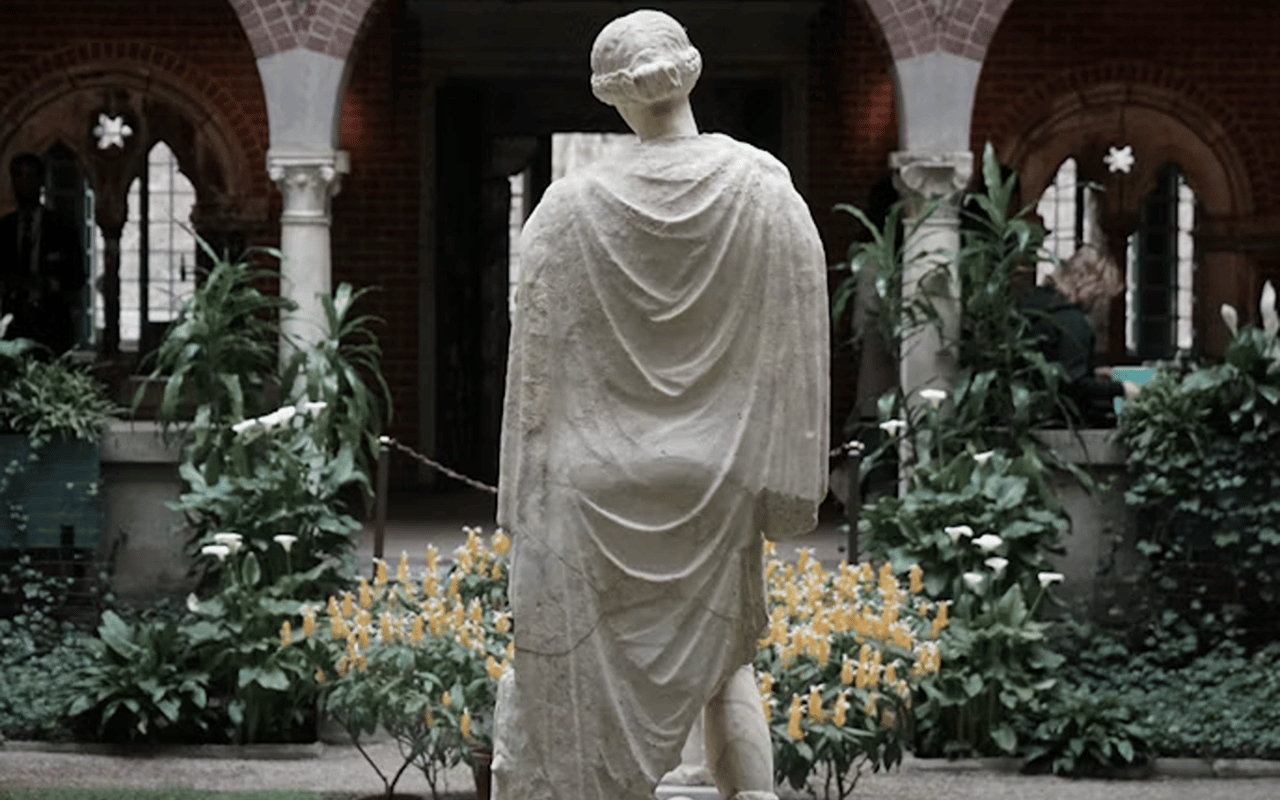
If one image defines the Gardner, it is the central courtyard. Surrounded by three levels of galleries and illuminated from above, the space blends sculpture, architectural fragments and an elaborate horticultural program.
- The courtyard changes with the seasons. Displays rotate throughout the year, featuring orchids, chrysanthemums, lilies and the museum's famous hanging nasturtiums.
- The plantings are carefully composed. Each display complements the architecture, sculpture, and changing New England seasons.
- Repeat visits feel different. The museum presents 10 seasonal courtyard displays, giving the space a distinct character from spring through winter.
That beauty makes the events of March 18, 1990, even more striking. Two men dressed as police officers entered the museum after midnight, restrained the guards, and stole 13 works, including Vermeer's The Concert and Rembrandt's Christ in the Storm on the Sea of Galilee. None have been recovered, and the museum continues to offer a $10 million reward for their return.
Several empty frames still hang where the missing works once appeared. Rather than conceal the loss, the Gardner has made it part of the museum experience, heightening the contrast between beauty and loss, particularly in the Dutch Room, where the absence remains impossible to ignore.
A Historic Palace That Is Still a Living Cultural Institution
Preserving Isabella's vision raised a difficult practical question: how to accommodate modern audiences without compromising the historic building or Gardner's original wishes.
Renzo Piano's New Wing provided the answer. Opened in 2012, the contemporary addition was deliberately separated from the Palace and connected by glass, keeping the historic building visually distinct. Piano described the project as a "respectful nephew to the great aunt."
- The 300-seat, cube-shaped Calderwood Hall performance space expands the Gardner's musical tradition, which dates back to the museum's opening night in 1903, and performances by musicians from the Boston Symphony Orchestra.
- The addition of contemporary galleries allows exhibitions to change.
- Programming such as concerts, artist projects, lectures, public programs and studio activities continue alongside the permanent collection.
The addition breathed new life into the museum, allowing The Palace to remain deeply tied to one woman's early-20th-century vision while staying relevant in modern times. Beyond the permanent collection, the museum's calendar includes a fall Weekend Concert Series, Thursday evening music, exhibition-related programming, and free Thursday admission from 5 to 9 p.m. Advance tickets are strongly recommended because popular times can sell out.
FAQs
Why is the Isabella Stewart Gardner Museum so unusual?
Unlike most major museums, the historic galleries largely preserve the arrangement the founder created. Paintings, furniture, sculpture, textiles, and architectural elements are displayed according to Gardner's personal aesthetic relationships rather than conventional chronological or geographic categories.
Are the empty frames from the 1990 theft still on display?
Yes. Several empty frames remain in their original locations, including in the Dutch Room. The museum has never recovered the 13 stolen works and continues to actively seek their return.
How much does it cost to visit the Gardner Museum?
General adult admission is $25; seniors 65 and older pay $22; college students with current identification pay $15; and visitors 17 and younger receive free general admission. The museum also offers free admission on Thursday evenings from 5 to 9 p.m., with advance reservations recommended.
Experience One of Boston's Most Singular Cultural Landmarks
The Isabella Stewart Gardner Museum is one of Boston's many cultural highlights and central to what makes Boston such an interesting place to call home. Neighborhoods such as Back Bay, Fenway, Beacon Hill, and the South End are surrounded by institutions whose histories are inseparable from the city itself.
For buyers and sellers considering luxury real estate in Boston, a wide range of exceptional residences offers proximity to museums, music, architecture, and cultural landmarks such as the Gardner. If you're interested in exploring buying or selling a luxury home in Boston, contact MGS Group Real Estate today to start your real estate journey. Let our team's years of experience and local expertise help you navigate Boston's luxury real estate scene.
ABOUT MGS GROUP REAL ESTATE
At MGS Group Real Estate, we go beyond brokerage to redefine what's possible in Boston luxury real estate and beyond. Founded by Maggie Gold Seelig, the #18-ranked individual real estate agent in the country by RealTrends for 2025, our group delivers a concierge-level experience that manages every aspect of your journey. With over $4 billion in sold real estate, our brokerage operates at the top of the market. We stand alone as the #1 boutique brokerage with offices in Boston & Wellesley and have set record sales in Boston, Brookline, Cambridge, Newton, Weston, Martha's Vineyard & New York City. This isn't ordinary real estate—it's the MGS Group experience.
Ready to buy or sell in Massachusetts, New York, Florida, or beyond? Contact us today and step into a new standard of real estate service with the MGS Group.
Ready to buy or sell in Massachusetts, New York, Florida, or beyond? Contact us today and step into a new standard of real estate service with the MGS Group.